 RapidBolt
Tap-End Studs for Australian Industrial Projects
Engineered supply, not off-the-shelf. Drawing-defined geometry, material traceability and a quoted lead time.
Tap-End Studs: specifications & dimensions
A tap-end stud has an installed end that engages a tapped component and an exposed end for a nut. The ends may have different threaded lengths or fits. Engagement, protrusion and hole clearance are engineering-controlled features; a tap-end designation does not automatically mean an interference fit.
- SUPPLY
- Buy-to-order · quoted lead time
- DIAMETER ENQUIRIES
- 1/4″–6″ · M5–M150; feasibility confirmed per grade
- GEOMETRY
- Order standard & approved drawing
- PRIMARY MARKETS
- Australia · Southeast Asia · Asia-Pacific
Installed-end and nut-end dimensional definition
Schematic shows a representative shorter installed end, not a mandatory ratio. No default engagement multiple or interference class is supplied.
| Feature | Reference | Engineering definition |
|---|---|---|
| Installed thread | L1 | Effective engagement in the tapped component, per drawing |
| Nut-end thread | L2 | Thread available for the joint stack, nut and specified protrusion |
| Installed fit | Tap end | Thread system and fit defined with the mating hole specification |
| Hole clearance | Drawing | Check tapped depth, drill depth, runout and end clearance |
| Body / length | DB / OAL | Body diameter, transitions and length datum defined separately |
ASME B18.31.2
Inch stud dimensional reference. Specify the applicable stud form, edition, end geometry and length convention; a material grade alone does not define these.
ASME B18.31.1M
Metric continuous-thread and double-end stud dimensional reference where specified. Do not convert inch dimensions into a metric tolerance schedule.
ASME B1.1 / ISO 261 & ISO 965
Inch or metric thread system, pitch and tolerance requirements as applicable. Define each end separately where fits differ and account for the specified coating.
ASTM A193 / A320 / A453 or alloy-specific standard
Material, heat-treatment and testing requirements selected for the service and product form. These are not substitutes for a dimensional drawing or an engineering suitability assessment.
ASME B1.12 — where specified
Class 5 interference-fit threads use a distinct modified National thread form; they are not simply a tighter ASME B1.1 Unified tolerance class. Apply only when the equipment design explicitly requires this system.
Thread retention must be specified, not assumed
The installed end may use a clearance, close or interference arrangement under the applicable design. Specify the stud and tapped-hole requirements together. Applying a tighter class without design approval risks damage or incorrect assembly.
Blind-hole depth is not usable engagement
Drill-point depth, incomplete tapped threads, stud end preparation and thread runout reduce the effective engagement available. The assembly must provide the drawing-required clearance rather than using the stud to bottom out in the hole.
Replacement follows the equipment drawing
Casings and tapped components can have different materials and thread strength from the stud. Engagement and installation requirements must follow the equipment designer; generic diameter multiples are not a substitute.
Material and geometry are separate decisions
B7, B7M, L7, B16, stainless, duplex and nickel alloy requirements must include the applicable product standard and condition. Matching nuts, coating, heat traceability and EN 10204 3.1 or 3.2 documentation are agreed for the order; no grade or geometry is automatically interchangeable.
REFERENCE BASIS
Selected reference sizes, not a complete tolerance schedule or a stock list. Confirm the current standard edition, material condition and drawing before manufacture or installation.
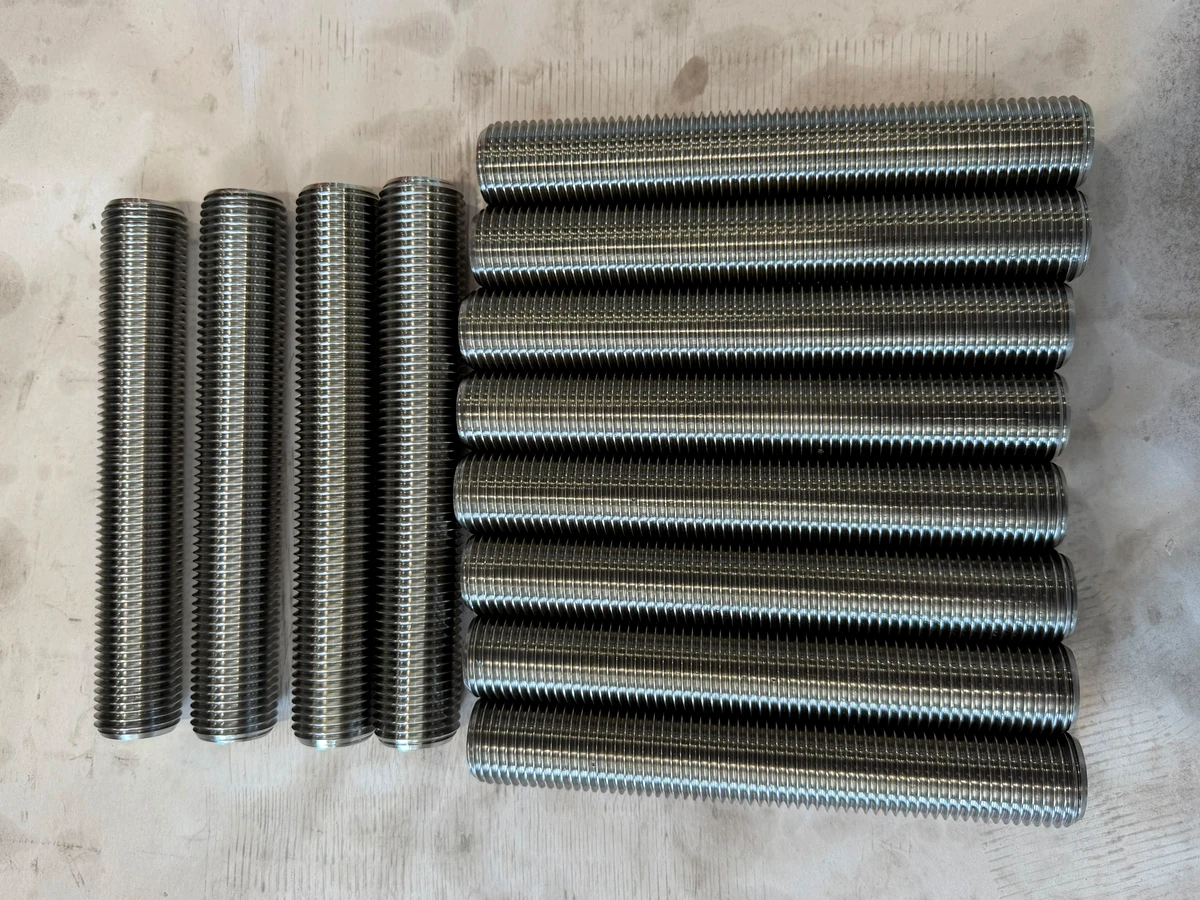
Overview
A tap-end stud has an installed end that engages a tapped component and an exposed end for a nut. The ends may have different threaded lengths or fits. Engagement, protrusion and hole clearance are engineering-controlled features; a tap-end designation does not automatically mean an interference fit. EMG manages supply through qualified manufacturing partners for Australian oil and gas, mining, power and industrial equipment projects, with Southeast Asia and Asia-Pacific support. Manufacturing operates under ISO 9001 quality systems; the drawing, material condition, inspection scope and documentation are agreed per order.
A tap-end stud has an installed end that engages a tapped component and an exposed end for a nut. The ends may have different threaded lengths or fits. Engagement, protrusion and hole clearance are engineering-controlled features; a tap-end designation does not automatically mean an interference fit.
Typical Applications
Fastener Types We Supply
Common Materials & Grades
Standards & Documentation
NEED MACHINED COMPONENTS TOO?
Spacers, blinds, special nuts, shafts and bushes — supplied to your drawing with the same traceability as your bolting. Precision Machined Components →
Technical FAQs
Does a tap-end stud always use an interference fit?
+
Is there a universal tap-end engagement length?
+
Can EMG quote tap-end replacement studs from a drawing?
+
Need a Quote for Tap-End Studs?
Send us the size, grade and quantity — or your drawings and bill of materials — and we'll return a technical quote for tap-end studs with lead times and certification included.
Phone
+61 (0)7 4055 6928Emergency Support
24/7 availability for critical projects